

Variational Autoencoders (VAEs) have emerged as a powerful tool in the field of machine learning, especially for tasks such as generative modeling, anomaly detection, and data compression. The sliding window technique, on the other hand, is a well - known method in signal processing and time - series analysis. In this blog, we'll explore how to use the sliding window for variational autoencoders, and also highlight our offerings as a sliding window supplier.
Understanding Variational Autoencoders
Before delving into the application of the sliding window technique, it's crucial to understand what VAEs are. A VAE is a type of autoencoder that adds a probabilistic twist to the traditional autoencoder architecture. In a standard autoencoder, the goal is to map an input to a lower - dimensional representation (the encoding) and then reconstruct the input from this encoding. VAEs, however, assume that the encoding is sampled from a probability distribution, typically a Gaussian distribution.
The encoder in a VAE outputs the mean and variance of the Gaussian distribution from which the encoding is sampled. This probabilistic approach allows VAEs to generate new data points similar to the training data. The decoder then takes the sampled encoding and tries to reconstruct the original input. The training of a VAE involves minimizing a loss function that combines the reconstruction loss (how well the input is reconstructed) and the KL - divergence loss (which measures how close the learned distribution is to a prior distribution, usually a standard Gaussian).
The Sliding Window Technique
The sliding window technique is a simple yet effective method for processing sequential data. Given a sequence of data points, a window of a fixed size is defined. This window slides over the sequence, one data point at a time (or multiple points at a time depending on the stride), and at each position, the data within the window is processed.
In the context of VAEs, the sliding window can be used in several ways. One common application is in time - series analysis. For example, if we have a time - series of sensor readings, we can use a sliding window to extract subsequences of a fixed length. These subsequences can then be used as inputs to the VAE.
Using the Sliding Window for VAEs
Data Preparation
The first step in using the sliding window for VAEs is data preparation. Suppose we have a time - series dataset (X = [x_1, x_2,\cdots,x_N]). We define a window size (w) and a stride (s). Starting from the beginning of the sequence, we extract windows of size (w) with a stride of (s).
Let (i) be the starting index of a window. The (i) - th window (W_i=[x_i,x_{i + 1},\cdots,x_{i+w - 1}]) is formed. The set of all such windows forms our new dataset for training the VAE. This new dataset has a shape that is suitable for the input of the VAE. For example, if the original time - series has a single dimension, each window has a shape of ((w,1)).
import numpy as np

def sliding_window(data, window_size, stride):
    num_windows = (len(data) - window_size) // stride+1
    windows = []
    for i in range(num_windows):
        start = i * stride
        end = start + window_size
        windows.append(data[start:end])
    return np.array(windows)


# Example usage
time_series = np.array([1, 2, 3, 4, 5, 6, 7, 8, 9, 10])
window_size = 3
stride = 1
windows = sliding_window(time_series, window_size, stride)
print(windows)
Training the VAE
Once we have prepared the data using the sliding window technique, we can train the VAE. The training process is similar to the standard VAE training, but with the new dataset of windows.
The encoder of the VAE will learn to map each window to a lower - dimensional probabilistic representation. The decoder will then try to reconstruct the original window from this representation. During training, we can monitor the reconstruction loss and the KL - divergence loss to ensure that the model is learning effectively.
import tensorflow as tf
from tensorflow.keras import layers

# Define the VAE model
class Sampling(layers.Layer):
    def call(self, inputs):
        z_mean, z_log_var = inputs
        batch = tf.shape(z_mean)[0]
        dim = tf.shape(z_mean)[1]
        epsilon = tf.keras.backend.random_normal(shape=(batch, dim))
        return z_mean + tf.exp(0.5 * z_log_var) * epsilon


latent_dim = 2

encoder_inputs = tf.keras.Input(shape=(window_size, 1))
x = layers.Flatten()(encoder_inputs)
x = layers.Dense(16, activation='relu')(x)
z_mean = layers.Dense(latent_dim, name='z_mean')(x)
z_log_var = layers.Dense(latent_dim, name='z_log_var')(x)
z = Sampling()([z_mean, z_log_var])
encoder = tf.keras.Model(encoder_inputs, [z_mean, z_log_var, z], name='encoder')

decoder_inputs = tf.keras.Input(shape=(latent_dim,))
x = layers.Dense(16, activation='relu')(decoder_inputs)
x = layers.Dense(window_size, activation='linear')(x)
decoder_outputs = layers.Reshape((window_size, 1))(x)
decoder = tf.keras.Model(decoder_inputs, decoder_outputs, name='decoder')

outputs = decoder(encoder(encoder_inputs)[2])
vae = tf.keras.Model(encoder_inputs, outputs, name='vae')

# Define the loss function
reconstruction_loss = tf.keras.losses.mean_squared_error(encoder_inputs, outputs)
reconstruction_loss = tf.reduce_sum(reconstruction_loss, axis=[1, 2])
kl_loss = - 0.5 * (1 + z_log_var - tf.square(z_mean) - tf.exp(z_log_var))
kl_loss = tf.reduce_sum(kl_loss, axis=1)
vae_loss = tf.reduce_mean(reconstruction_loss + kl_loss)

vae.add_loss(vae_loss)
vae.compile(optimizer='adam')

# Train the VAE
vae.fit(windows, epochs=10, batch_size=2)
Applications
Anomaly Detection
One of the most important applications of using the sliding window for VAEs is anomaly detection in time - series data. After training the VAE on normal data (using the sliding window technique), we can use the trained model to detect anomalies.
Given a new time - series, we again use the sliding window to extract windows. We then pass these windows through the trained VAE and calculate the reconstruction error for each window. If the reconstruction error of a window is above a certain threshold, we can consider that window (and potentially the corresponding part of the time - series) as an anomaly.
Generative Modeling
The sliding window approach can also be used for generative modeling of sequential data. Once the VAE is trained on a dataset of windows, we can sample from the latent space and use the decoder to generate new windows. These generated windows can then be combined to form a new time - series.
Our Sliding Window Offerings
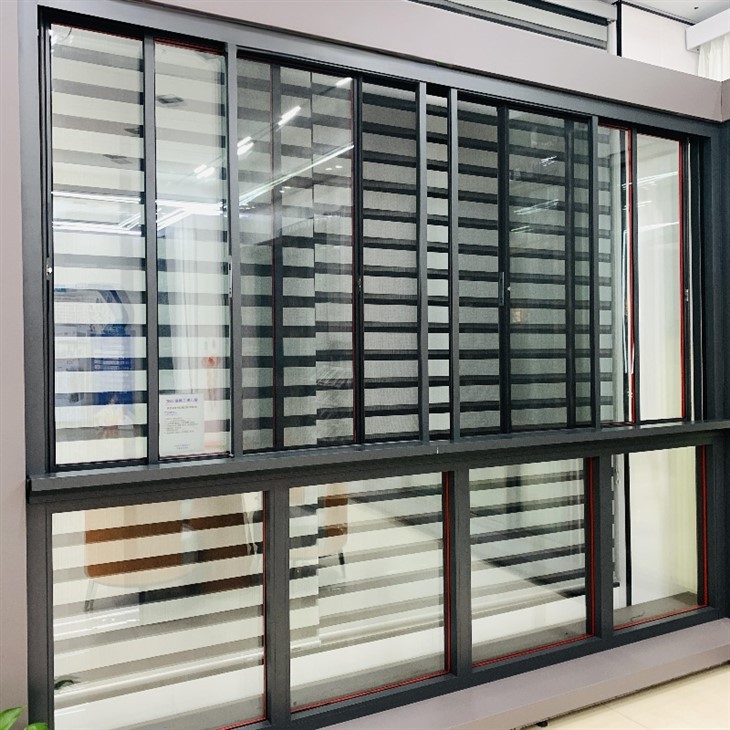
As a sliding window supplier, we offer a wide range of high - quality sliding windows. Our Gliding Windows are known for their smooth operation and durability. They are designed to provide excellent ventilation and natural light while maintaining energy efficiency.
Our Horizontal Sliding Storm Windows are specifically engineered to withstand harsh weather conditions. They offer an extra layer of protection for your home or office, reducing energy costs and noise pollution.
For those with specific requirements, we also provide Custom Sliding Window solutions. Our team of experts can work with you to design and manufacture sliding windows that fit your exact needs, whether it's a unique size, shape, or style.
If you are interested in our sliding window products or have any questions about using the sliding window technique in machine learning applications, we encourage you to contact us for further discussion and procurement. We look forward to working with you to meet your needs.
References
Kingma, D. P., & Welling, M. (2013). Auto - encoding variational bayes. arXiv preprint arXiv:1312.6114.
Bishop, C. M. (2006). Pattern recognition and machine learning. Springer.